
Town of Lockport City Directory Collections
Start at the Lockport Public Library Local History Room. Its local directory series runs from 1856 to the present in microfilm and print. The Niagara County Genealogical Society is known as NCGS. It lists a directory run from 1856 to 1999 on its lookup form. County Historian holdings add directory records from 1856. They also keep family files, maps, church material, census resources, and obituaries. Treat them as complementary collections. They form no single continuous online database. Note the volume year, street, and municipality each time a name appears.
| Collection | Years | Where Held | Access |
|---|---|---|---|
| Lockport directory run | 1856-present | Lockport Public Library | Microfilm and print in the Local History Room |
| NCGS Lockport directory run | 1856-1999 | Niagara County Genealogical Society | Five-year-range lookup request or in-person research |
| Webb & Fitzgerald directory example | 1868 | Ancestry collection | Digitized scan, with access conditions set by the collection |
| NARA-listed Lockport directories | 1927-1929, 1931 | National Archives listing | Holding reference for those selected years |
| County Historian directory holdings | From 1856 | Niagara County Historian | Ask for the in-house index or research access |
| County Historian historic files | Obituaries from the 1840s; marriage from 1908; Census from 1850; naturalization from 1836 | Niagara County Historian | In-house directories, church records, family files, diaries, and maps |
| Local newspaper microfilm | 1858-1859; 1866-1899; Oct. 1899-present; 1883-1884 | Lockport Public Library | First-come scanner access; obituary index is partial |
| Lockport High School yearbooks | 1897-present | Lockport Public Library | Print volumes, useful as a companion source |
| DeSales Catholic High School yearbooks | 1950-1989 | Lockport Public Library | Print volumes, useful as a companion source |
| Federal Census | 1820-1930 except 1890; 1940 and 1950 online | Library and approved digital access | Microfilm or online, subject to the 72-year release rule |
| New York State Census | 1855, 1865, 1875 | Library and NCGS | Microfilm and printed index; town coverage can be incomplete |
| Sand and Polster photographs | Sand mostly 1919-1949; Polster mainly 1940s-1960s | Library and NY Heritage | Local binders and digitized collection context |
| Lockport oral histories | 1999-2006 | Library and NY Heritage | Searchable interviews; 52/56-person extent discrepancy |
| Lockport Sanborn maps | 1903 | Library of Congress | 28-sheet City building and street context |
A directory volume is a dated clue, not a complete annual roll. Coverage shifts from year to year. The library advertises no separate reverse-directory run. So ask staff whether a particular volume is arranged by address or carries a classified or reverse section. Ask before you lean on it for a street search.
Town of Lockport Library Directory Access
The Local History Room is on Floor 3 of the library at 23 East Avenue. It serves researchers whenever the library is open. Listed hours are Monday through Thursday, 9 to 8, and Friday, 9 to 5. Out-of-town researchers can get a guest pass. Two microfilm scanners run first come, first served. You will need a library card or guest pass, and a one-hour limit applies when someone else is waiting. Prints cost 15 cents.
Local History Room
Lockport Public Library
23 East Avenue, Floor 3
716-433-5935
NCGS Research
Niagara County Genealogical Society
215 Niagara Street, second floor
Lookup sheet offers directory, Census, and cemetery requests.
County Historian
Niagara County Historian
139 Niagara Street
716-439-7324
Library staff will check indexed sources and newspapers for an obituary. That service applies if you supply a death date. They cannot take on a full Census project. The NCGS allows one member lookup per year. Beyond that, it lists $6 obituary searches and $10 for a 30-minute lookup. Requests work best with a specific date or week. Add the city and the exact spelling of the name.
Note: Bring the exact year, address spelling, and municipality. This aims the request at the right local source.
Reading Town of Lockport Directory Entries
The digitized 1868 Lockport volume came from Webb & Fitzgerald. It packs in general and business material, city government, and institutions. It also holds societies, a historical sketch, and Niagara post offices. Each volume needs its own key. A name may carry an occupation. It may list a business address, or a home address marked with an “h.” Watch the small stuff. Initials, widow notations, and field order can shift. They differ from one publisher and year to the next.
| Name | Surname, given name, initials, and sometimes a widow or spouse notation. |
|---|---|
| Occupation or business | Work, employer, or a business description that may have its own address. |
| Home clue | A street number and street; in the 1868 example, “h” identifies the home address. |
| Year context | The volume date that fixes the listing to one point in time. |
| Street sequence | Nearby entries that can help distinguish a home address from a business location. |
- Criss-cross directory
- An address-ordered section, if a volume includes one, used to look from street to listed name.
- Householder index
- An index organized around a household or address rather than the usual surname order.
- Abbreviation key
- The publisher’s explanation of short forms. Photograph or note it before interpreting “h,” initials, or widow marks.
The 1868 directory scan is a handy primary-volume reference. Access may require a collection login, so for a local, in-person route use the library's printed and microfilm material.
Town of Lockport Directory Boundaries
The word “Lockport” alone cannot settle jurisdiction. The Town of Lockport formed in 1824. The City of Lockport organized separately in 1865. The town surrounds the city. Most of the volumes primarily describe the city and its nearby urban area, not the open town. A rural Town of Lockport road may be missing, or indexed under a hamlet, post office, or road name. Check the address first. A City Clerk certificate or volume listing should not serve as Town evidence until that step is done.
Older geography survives in historical sources too. The Town Historian identifies Wrights Corners, Hickory Corners, Warrens Corners, Rapids, and Raymond as local hamlets. Hamlet names matter here. Keep the original place wording from a directory exactly as written. Then compare it with the street, nearby roads, the legal description, and later maps. No official Town-wide street renumbering or renaming year appears in the local record.
Note: A missing entry can reflect coverage, spelling, a business listing, or local geography rather than absence from the Town of Lockport.
Trace Town of Lockport Directories
Work the directory series as an annual sequence. Then test it against the slower Census record. The library's federal Census material covers Niagara County from 1820 through 1930, except 1890. The 1940 and 1950 records are online. State material exists too. New York State Census records are available for 1855, 1865, and 1875. A directory lists a head of household, an occupation, and an address. A Census adds household members, approximate ages, and relationships. Neither proves continuous occupancy.
- Start with the name, address, and directory year already known.
- Read the street sequence and abbreviation key, then record every surname, home mark, occupation, and business address at that location.
- Check the prior and next directory volumes for a move, a changed spelling, or a new household listing.
- Pair the directory year with the nearest federal or New York State Census, keeping their dates and addresses separate.
- Use a deed, obituary, probate record, or newspaper notice to test a departure, sale, or death.
Need a current parcel? Use the Town of Lockport By Street reference instead of a historical directory, which cannot supply a modern property result.
Town of Lockport Directory Companions
A city-directory clue in the Town of Lockport often opens more doors at the library. The newspaper shelves there hold real runs. These include the Lockport Daily Advertiser & Democrat for 1858 to 1859, the Daily Union/Sun for 1866 to 1899, and the Union Sun & Journal from October 1899 to the present. The Niagara Democrat covers 1883 to 1884. Obituaries are a natural next step. The obituary index, though, reaches only selected Union Sun & Journal years. Those years are 1900 to 1903 and 2007 to 2011. Most newspaper years lack a full index, so give staff a date range when you request an obituary check.
Yearbooks work well alongside a residents directory entry. They supply names, portraits, classes, and activities. The County Historian widens the lens further. It lists obituaries from the 1840s and marriage records from 1908. Census material goes back to 1850. Naturalization records start in 1836. The office also holds church records, diaries, and maps. Each source adds context around a listing. None of them converts an old entry into a present address. Treat them as companions rather than shortcuts.
Note: A dated newspaper notice confirms one event or mention, not every person who ever lived at the address.
Town of Lockport Oral History Context
Paper directories name people. The NY Heritage Lockport oral-history collection lets them speak. Interviews recorded from 1999 to 2006 cover people born roughly 1899 to 1960, and they shine on places, schools, civic life, and family context. They are not, however, a complete resident roll for the Town of Lockport.
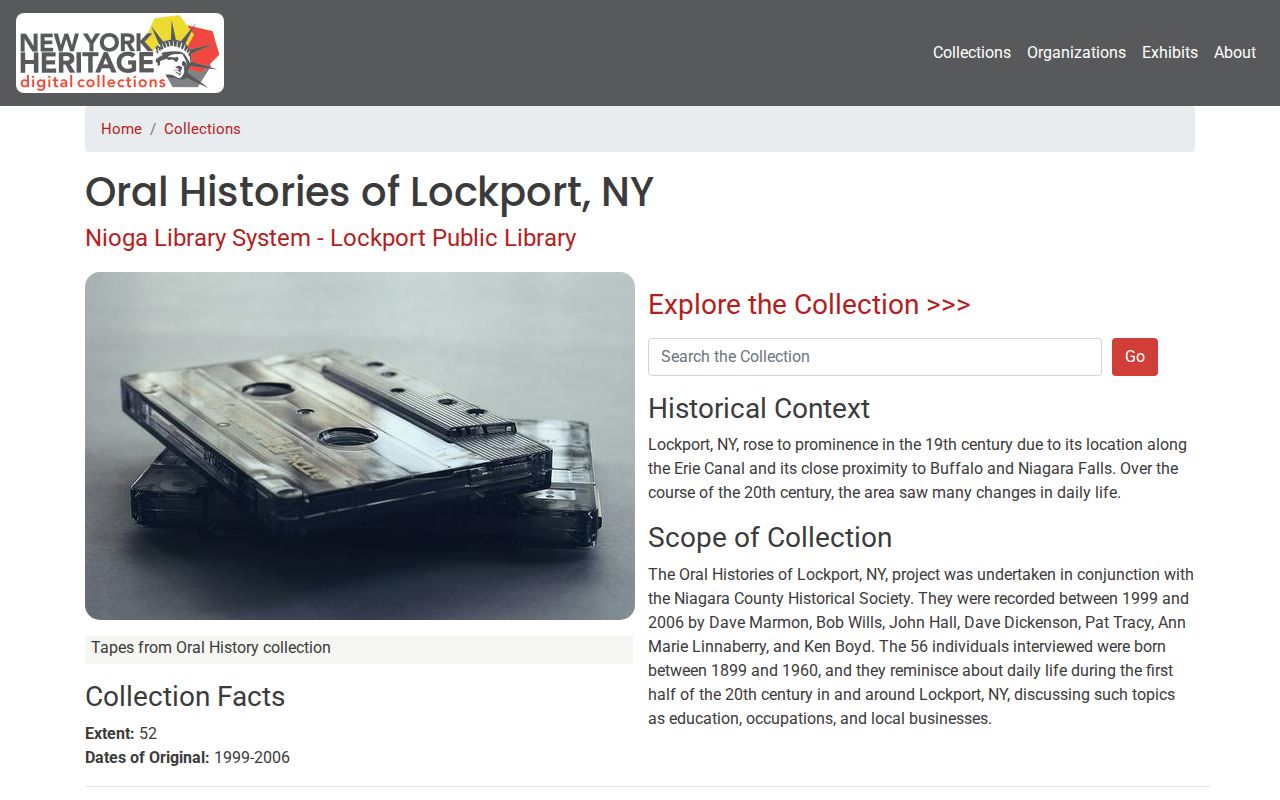
One counting gap deserves care. The oral-history record reports an extent of 52. The library describes 56 people. Keep that difference in a research note rather than merging the two figures. For visual context, the library's Sand and Polster photograph collections pair nicely with a directory or newspaper naming a place.
The Sand collection holds roughly 4,200 photographs, most from 1919 to 1949. Prints sit in Local History binders arranged by last name. A separate index covers people, companies, organizations, and events. The Polster collection adds more than 500 local images. It is strong on downtown, schools, churches, civic life, industry, and Erie Canal scenes from the 1940s through the 1960s. A photograph supports place context. It still cannot replace the dated directory entry or a property record.
Town of Lockport Collection Limits
Some limits are plain. Local sources establish no public reverse-directory run. There is no exact historical cutoff for every rural Town address. And no complete online index spans all newspaper years. Ancestry Library Edition at the library works only on-site or through its connected Wi-Fi. It is not a remote public subscription. The Niagara History Center offers curator research by appointment. It also points genealogy researchers to NCGS for lookup services.
Citation habits matter. Record the volume title, year, page, street spelling, and municipality for every entry you use. For an ownership question, set the dated directory volume beside a recorded deed or assessment record. For a family question, compare it with Census and obituary evidence. That discipline preserves what the entry actually proves: a historical listing at a stated time.